

A strategic water source for the whole of Slovakia
Žitný Ostrov is the largest groundwater reservoir in Slovakia and one of the most important water bodies in Central Europe. An estimated 10 billion cubic metres of water lie beneath it, which works out as if every Slovak had their own Olympic swimming pool of drinking water. It is not a standing reserve but a living system that is constantly renewed and depends directly on natural processes.
The geology of the area made this huge store of water possible. Žitný Ostrov is in effect a large natural depression which the Danube, over a long time, filled with boulders, gravel and sand. Water then collected between those layers and is continually replenished, above all by infiltration from the Danube. As it moves through the gravel and sand it is naturally filtered and enriched with minerals. The result is exceptionally good drinking water, one of Slovakia’s most valuable natural resources.
Water that is constantly renewed
One of the remarkable features of Žitný Ostrov is that the water underground does not “stand still”. It keeps flowing in, passing through the subsoil and flowing back into the river system. The reserves are therefore continually renewed and, under normal conditions, can be treated as practically inexhaustible. That exception holds only for as long as the water stays clean.
The greatest risk for Žitný Ostrov is therefore not only a possible loss of water, but above all its contamination. Water can still be present underground, yet once it is polluted it ceases to be usable as a safe source of drinking water. That is the greatest concern of the people who have long worked to protect the groundwater of Žitný Ostrov.
The greatest threat: the Vrakunská landfill
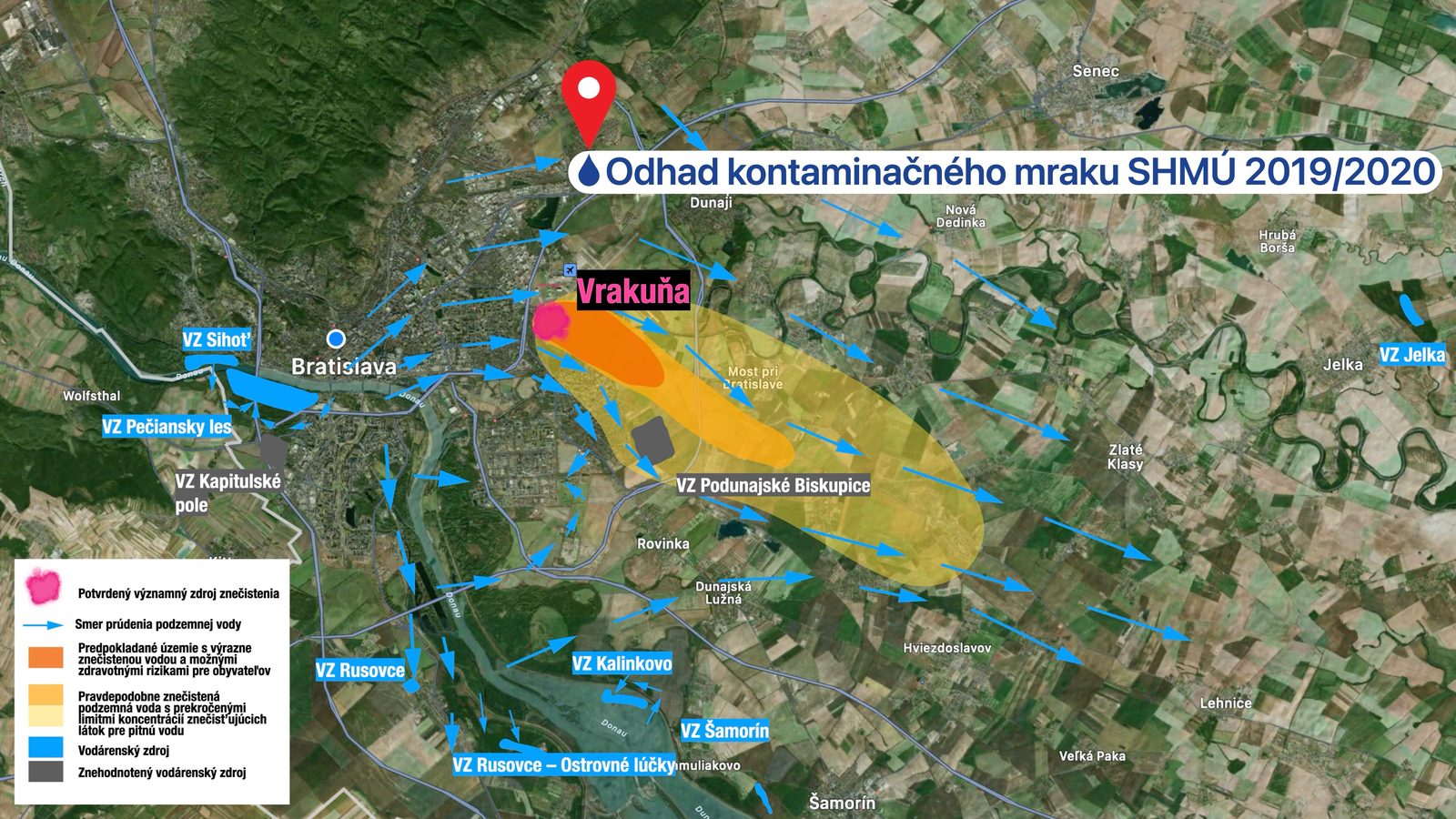
The Vrakunská landfill has long been described as the most serious risk to the groundwater of Žitný Ostrov. It is an old environmental burden containing waste from the former Juraj Dimitrov chemical works, later Istrochem. That waste is a mixed chemical cocktail, and the landfill sits on land from which contamination can spread towards Žitný Ostrov.
According to the civic association Za našu vodu, this is a problem that has been named for years, while a real solution has still not even begun. That is one of the gravest messages of the whole subject. Many people assume that, because the Vrakunská landfill has been discussed for so long, the state must already have dealt with it. In reality, activists say, toxic waste is still leaking into the groundwater and the risk to Žitný Ostrov continues.
The greatest threat is not only the existence of the landfill, but the fact that the contamination spreads slowly and over a long time. The problem may not be obvious at first glance, yet its consequences can appear years later in the quality of groundwater and then of drinking water.
Contamination does not have only one source
The Vrakunská landfill is not the only risk. Groundwater on Žitný Ostrov is also threatened by other factors. They include human activity on the island itself, especially careless handling of chemicals, pesticide residues from farming, leaks of oil products, or pollution from private land.
Because groundwater in many places on Žitný Ostrov lies very close to the surface, even a seemingly small lapse can send a problem underground. If people wash a car in the yard, pour petrol into a mower, handle oils, or use chemical products without care, contamination can reach the groundwater very quickly. The vulnerability of the area means that protecting water on Žitný Ostrov is not only a matter of large state problems, but also of everyday behaviour.
The atrazine case as a warning
A strong impulse for founding our civic association Za našu vodu was an event in 2018, when atrazine, a substance once used as a herbicide, appeared in the drinking water of five municipalities on Žitný Ostrov. Atrazine had already been banned in the European Union, yet the contamination still reached groundwater used for drinking.
It is assumed that this was the result of an illegal dump or of old stocks of the substance being stored unlawfully, which over time began to leach from the ground. The contamination then advanced to the wells from which the municipalities drew drinking water. For a time residents depended on tanker trucks, and later the problem was handled with filters that could remove atrazine.
The case showed two fundamental things. First, that illegal or irresponsible handling of chemicals can have consequences many years later. Second, that contamination may be discovered only when it has already reached drinking-water sources. That is exactly the situation a working system of water protection should try to prevent.
How the association Za našu vodu began
The civic association Za našu vodu was founded in response to that incident, and it gradually grew into a broader initiative of ecologists, engineers, activists and other people in public life. Its aim is not only to point out risks, but above all to explain to the public why groundwater matters and how it is connected to the drinking water in our homes.
One of the association’s greatest contributions, in our view, is precisely awareness-raising. Groundwater is an abstract subject for many people. They do not see it, so they do not realise that the water they drink every day often comes from it. The association therefore tries to bring the subject as close as possible and to explain that drinking water is not a given, but the result of a sensitive natural system that can be damaged.
Important successes of our association also include raising pressure on institutions to treat problems such as the Vrakunská landfill more seriously, and cooperation with water companies on more detailed testing of water sources.
Monitoring as the key to protecting water
One of our main ambitions is not to build our own monitoring network, but to press for existing data on groundwater quality to become part of a comprehensive monitoring system that can not only measure the current state, but also predict how contamination will spread.
That is a fundamental difference from the present. Today a problem is often found only when contamination has already reached a well or a water source. Properly set monitoring should let water companies and the responsible institutions know in advance that a particular kind of pollution is approaching their sources, and give them time to act. Prevention is incomparably cheaper and more effective than dealing with the consequences.
That is why the association stresses the need for a system that will not only collect data, but will know how to use it to predict risk and protect water sources.
Education for children and adults
A significant part of our association’s work is with the public, including children. Children can carry this subject into families. To explain how groundwater works and what pollution risks look like, the association also uses 3D models that show how water enters the ground, how clean groundwater is formed, and how it can be polluted.
On these models it is possible to show very clearly how contamination reaches underground layers, how quickly it can hit a drinking-water source, and what different sources of pollution play a part. Children and parents can be shown that pollution does not have to come only from large factories, but also from everyday activities such as using oils, pesticides, or handling waste badly.
For example, a single litre of oil can contaminate thousands of litres of water, which is a very strong and understandable picture of how sensitive groundwater is to human carelessness.
An award as confirmation that the work matters
Experts in environmental awards also noticed the association’s work, and the initiative received nationwide public recognition through the VÚB Foundation’s Atlas award. For us, the members, it was not only a symbolic prize, but confirmation that the work matters and that protecting groundwater can reach people across society.
Such recognition has an important role in civic life. It helps keep energy, motivation and the belief that even a smaller group of people can open important public subjects and move them into public debate.
Water protection and the climate crisis
Za našu vodu now sees the subject of water more broadly. It is no longer only about protecting Žitný Ostrov and drinking-water sources in Slovakia, but also about the wider context of the climate crisis. That crisis affects the availability of water in other parts of the world too, especially where water sources are naturally limited.
That is why the association has also become interested in cooperation on projects in Africa, where wells drying up because of climate change threaten local communities. The aim is to connect the building of wells with planting dense forest stands that would help hold water in the landscape. This reach shows that the question of water has long ceased to be only a local problem and is one of the most important global subjects of our time.
In our view the state still reacts too late
The state does formally treat some environmental problems as important, but in practice it solves them slowly, or only when they become very visible. With water and environmental burdens that is especially dangerous, because waiting can mean further years of contamination spreading.
The Vrakunská landfill is again an example. We welcome that there is now open talk of the need not only to close the landfill, but to excavate the waste and dispose of it safely. At the same time we warn that without concrete steps, and without a pace that matches the seriousness of the problem, a whole electoral term can pass again with no real solution moving forward.
Dilution is not a solution. The fact that contamination is diluted to some extent in a huge volume of water does not mean it stops being a problem. If the pollution reaches water sources, removing it will be extremely expensive and technically demanding.
What to do if we suspect water contamination
Finally: what should a person do if they have doubts about the quality of drinking water in their municipality or in their own well? First it is necessary to distinguish water supplied by a water company, water from municipal sources, and water from private wells.
For water from a water company, basic quality information is usually available on websites or on water bills. For municipal sources, residents should require the municipality to publish water-analysis results transparently and regularly. It is very important to ask which substances are actually analysed. Ordinary monitoring often covers only basic indicators, not the whole spectrum of risky chemicals.
With private wells the situation is even more sensitive. People who drink water from their own well should have it checked at least once a year. A basic test, for example for nitrates, is not enough. Such an indicative measurement does not mean the water is automatically safe. A comprehensive analysis should cover a much wider spectrum of substances, especially in an area with intensive farming or a possible influence of environmental burdens.
Drinking water as a subject that concerns everyone
Protecting drinking water is not a marginal environmental subject for a narrow circle of activists. It is a question of the health, safety and quality of life of every person. Water is a condition of life, not an ordinary commodity that can be decided about without long-term responsibility.
Žitný Ostrov is an enormous wealth of Slovakia, but that wealth will not be kept automatically just because we have it. It will be kept only if we take an interest in it, if we require responsible steps from the state and from local governments, and if we ourselves realise that everyday behaviour has a direct effect on the quality of the water under our feet.
We have to protect drinking water before we start to lose it.
Tags: #ZitnyOstrov #DrinkingWater #Groundwater #WaterProtection #VrakunskaLandfill #EnvironmentalBurden #WaterContamination #Atrazine #WaterMonitoring #ZaNasuVodu #WaterSources #Environment #ClimateCrisis #PublicHealth